REVIEW · KYOTO
Kyoto: Gion Geisha District & Sake-in-Hand Walking Tour
Book on Viator →Operated by Otatrip Guide · Bookable on Viator
Gion looks magic after dark. This small-group walk threads through historic streets, adds geisha-culture context, and pairs it with a sake tasting as you go.
What I like most is how the route is designed so you can see key landmarks without getting turned around in the narrow lanes. I also like that you get practical guidance on what to notice as you pass places like Hanamikoji Street and Yasaka Shrine, plus stories tied to samurai culture and Zen meditation.
One thing to consider: the pace is relaxed and it’s more about the atmosphere and the guided walk than nonstop back-and-forth. If you expect lots of interaction at every step, you might find it a bit calmer than you hoped.
In This Review
- Key reasons this Gion night walk is worth your evening
- Gion after dark: what changes when the lights come on
- Small-group walking (max 10) and why it matters in Gion
- Getting oriented: starting near Kikunoi Roan and finishing at Yasaka Shrine
- Stop 0: the Kamo River warm-up you’ll feel in your feet
- Stop 1: Gion streets and what to notice beyond storefronts
- Stop 2: Hanamikoji Street and the appeal of preserved machiya
- Stop 3: Yasui-Konpiragu Shrine, relationships in Shinto form
- Stop 4: Hokan-ji Temple and the Yasaka Pagoda moment
- Stop 5 & 6: Sannenzaka and Ninenzaka slopes for classic Kyoto street vibes
- Stop 7: Nene-no-Michi, a serene path with a strong name
- Stop 8: Yasaka Shrine finish, the night energy you’ll remember
- The sake-in-hand part: why it fits the route
- Walking notes: comfort matters more than you think
- How much interaction should you expect?
- Price and value: is $27.84 fair for this experience?
- Who should book this Gion Geisha District & Sake-in-Hand Tour?
- Should you book? My practical take
- FAQ
- FAQ
- How long is the Kyoto Gion Geisha District & Sake-in-Hand walking tour?
- Where does the tour start and where does it end?
- Is the tour really a small group?
- What’s included besides walking and sightseeing?
- Is there an age requirement?
- Is the tour suitable for people with mobility issues?
- Does the tour include admission tickets?
- Will the tour run in bad weather?
- What if I need to cancel last-minute?
Key reasons this Gion night walk is worth your evening
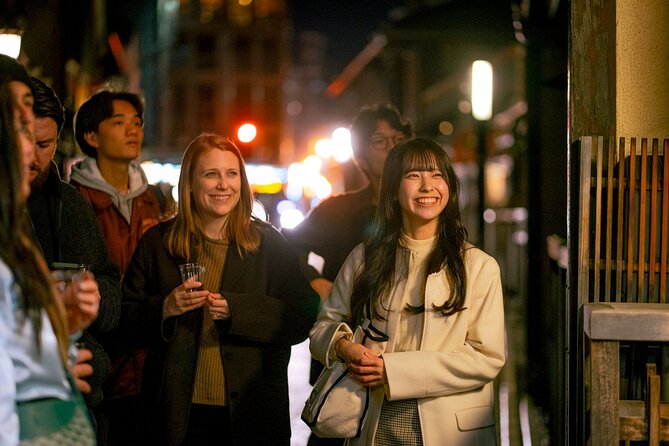
- Lantern-lit Gion backstreets with less stress (you follow a plan instead of guessing turns)
- Geisha-culture commentary with tips on what to look for in Gion
- Sake in hand included on the tour, with alcohol provided responsibly
- A tight max group size (10 travelers) for a more personal vibe
- Big “Kyoto icons” in a compact route: Yasaka Shrine and Hokan-ji’s five-story pagoda
Gion after dark: what changes when the lights come on
Kyoto’s Gion district has a totally different mood at night. By the time lanterns glow along narrow streets, the area feels quieter and more “story-like” than it does in daylight. That shift matters here, because the tour is built around walking through Gion’s alleys and side lanes, not just posing at the obvious spots.
You also don’t just get sightseeing. The guide commentary is meant to give you cultural context—especially around geisha culture—so you can interpret what you’re seeing. It’s the difference between watching a movie scene and understanding why those details exist.
The sake component is a real tone-setter. When you’re holding your cup while you move through the streets, you’re in the right headspace for a night tour: slower, more observant, and ready to notice small cues you’d otherwise miss.
You can also read our reviews of more walking tours in Kyoto


Small-group walking (max 10) and why it matters in Gion
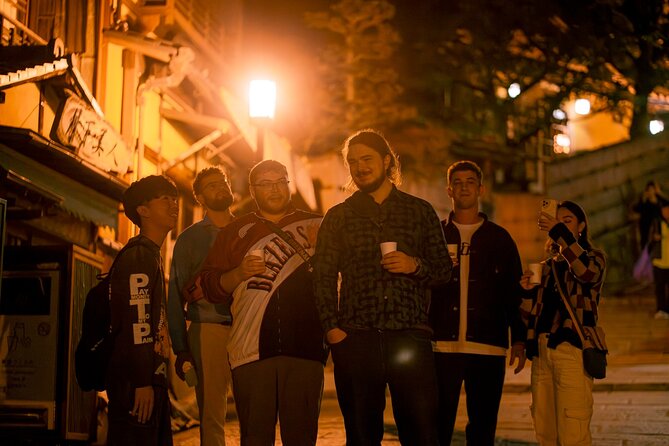
This is a maximum of 10 travelers, which is a practical detail in a place like Gion. Smaller groups spread out better in tight alleys, and it’s easier for the guide to keep track of everyone. It also makes it more likely you’ll get quick answers to questions as you go.
The tour runs about 1 to 1.5 hours, so you’re not committing to a whole evening. That time window is a good match for visitors who want a signature night experience without sacrificing all your energy for later dinner plans.
One more practical note: the tour moves through residential areas at night. You’re asked to keep voices down and be respectful. That’s not just polite—it helps the group move smoothly through quieter lanes and makes the experience feel more like a local stroll than a parade.
Getting oriented: starting near Kikunoi Roan and finishing at Yasaka Shrine
You’ll start at Kikunoi Roan (600-8012 Kyoto, Shimogyo Ward, Saitōchō, 四条下る斎藤町118) and end at Yasaka Shrine (625 Gionmachi Kitagawa, Higashiyama Ward). Ending at Yasaka Shrine is handy because it keeps you near one of the most central night destinations in the area.
If you need help getting onward, the tour includes support to catch a taxi if possible or return to the start point if requested. That matters because nighttime schedules for buses can get thin.
It’s also described as being near public transportation, which is a relief if you’re mixing this with other Kyoto stops. You’ll want to plan a loose connection, though—this is a walking tour, and the pace plus lantern-lit streets can make you linger if you’re enjoying it.
Stop 0: the Kamo River warm-up you’ll feel in your feet
The route begins around the Kamo River, which runs through the heart of Kyoto. It’s described as picturesque and tranquil, with historical significance, and the riverbanks are lined with cherry blossom trees.
That first section matters because it helps your brain shift from street pace into walking pace. You’re not immediately deep in dense alleyways—you get a scenic buffer first. It’s also a simple way to take in Kyoto’s atmosphere before you focus on geisha district details.
Practical tip: this is a good moment to look up and ahead. If you’re prone to stopping for photos, now is the time to do it without derailing the flow, because you’re still in a more open stretch than the inner streets.
Stop 1: Gion streets and what to notice beyond storefronts

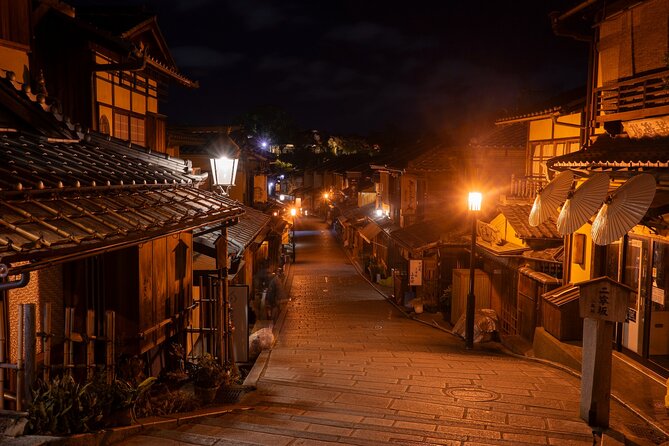
Gion is Kyoto’s best-known geisha district, and the tour takes you right into the historic lanes where that reputation comes from. You’ll walk past traditional wooden machiya houses and teahouses, along with the lively nighttime atmosphere of the neighborhood.
What I like about having this as the first main district stop is that it lets you calibrate your attention. The guide commentary is aimed at helping you recognize what’s part of the culture and what’s just a set dressing for visitors. You’re also guided on where you might spot a geiko/geisha-related scene—without pressuring anyone to perform for you.
If you want the best experience, keep your focus on behavior and setting: how people move, where lights are placed, and how the streets narrow toward teahouse frontage. In Gion, the “why” is often as important as the “what.”
You can also read our reviews of more food & drink experiences in Kyoto


Stop 2: Hanamikoji Street and the appeal of preserved machiya
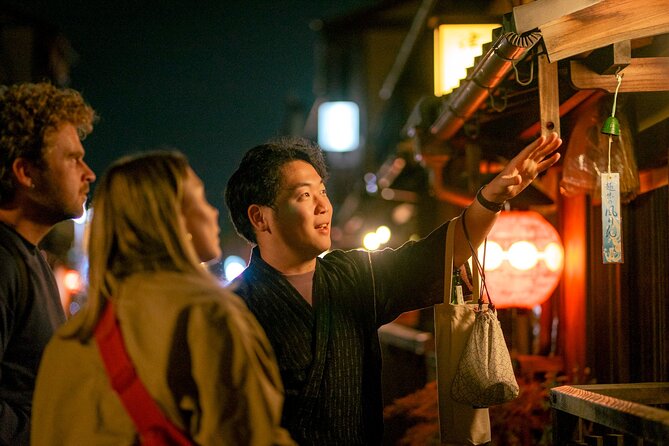
Next comes Hanamikoji Street, described as historic and enchanting, lined with preserved wooden machiya houses and traditional streetscape.
Hanamikoji is famous for a reason. Even if you’ve seen photos before, walking it at night hits different because the preserved buildings and lantern light turn the street into a visual timeline. You get a sense that this is not a single attraction—it’s a district with layers.
Watch for the rhythm of the street. The lanes are narrow and you’ll be moving with the group, so you’ll get better results if you keep your camera ready but don’t block the flow. The goal is to enjoy the view while still staying in stride with the walk.
Stop 3: Yasui-Konpiragu Shrine, relationships in Shinto form
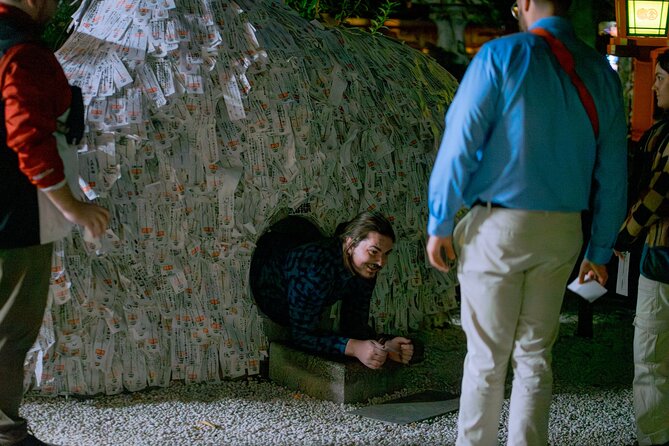
Yasui-Konpiragu Shrine (Yasui Konpiragu) is in the Higashiyama district, and the tour gives you a reason to stop beyond sightseeing. It’s known for a power to sever bad relationships and bring good ones.
The shrine is also noted as being famous for its large Enki (the listing specifically mentions a large Enki). That’s a useful detail because it hints at why the shrine is spiritually meaningful in a very practical-feeling way—people go there for a particular kind of hope.
At this stop, slow down. Even if you’re moving between landmarks, take a moment to observe how people approach the shrine space. That’s where you start feeling why Kyoto couples religion and daily life so naturally.
Stop 4: Hokan-ji Temple and the Yasaka Pagoda moment

From the shrine world, you transition to Hokan-ji Temple, commonly known as Yasaka Pagoda. It’s iconic and five-story, and the listing notes it dates back to the 6th century.
This is one of the stops where you’ll likely understand why guides love walking routes like this. A pagoda silhouette changes how you see the entire area. Once you’ve got that five-story landmark in your view, the surrounding streets feel like they’re supporting the structure instead of interrupting it.
There’s also a practical benefit: the “pagoda stop” gives you a natural break where your legs might thank you. Because you’re in a guided flow, you’re not searching for where to pause and regroup.
Stop 5 & 6: Sannenzaka and Ninenzaka slopes for classic Kyoto street vibes
The tour includes both Sannenzaka and Ninenzaka, both in the Higashiyama district. These are known for a traditional pedestrian atmosphere and preserved wooden buildings.
One is described as a gently sloping path (Ninenzaka), while the other is described as a stone-paved slope adjacent to it (Sannenzaka). Together, they give you a sense of how Kyoto’s older streets weren’t designed for fast movement—they were designed for walking, wandering, and noticing.
This pair is also built for photo stops, but the best way to handle photos is the same as in any historic pedestrian area: pause briefly, don’t stop in the middle, and let the group keep moving. Since your time is limited to roughly 1 to 1.5 hours, those slope minutes are part of the experience, not extra time you can always take later.
Stop 7: Nene-no-Michi, a serene path with a strong name
Nene-no-Michi is named after Nene, the wife of Toyotomi Hideyoshi. The listing describes it as a serene and picturesque stone-paved path in the Higashiyama district, and it connects between major temple areas in that neighborhood.
This is a calmer stop in the route, which I appreciate. After the “street-scope” of Sannenzaka and Ninenzaka, the Nene-no-Michi segment gives you a quieter stretch where you can think about what the guide has been explaining: culture, faith, and how people move through the city.
If you’re the type who likes a moment of quiet during your sightseeing, this is a good time to let your senses catch up. You’re walking through stones and shadows, not racing from one viewpoint to another.
Stop 8: Yasaka Shrine finish, the night energy you’ll remember
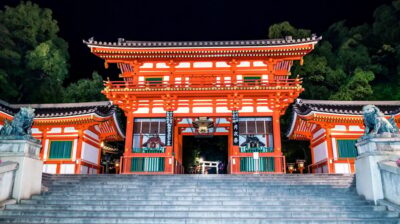
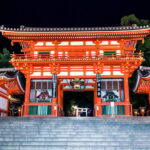
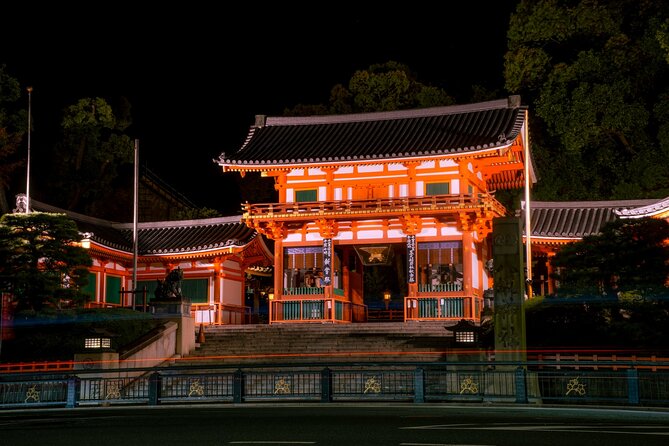
You end at Yasaka Shrine, also known as Gion Shrine. The listing says it dates back to 656 AD and is one of Kyoto’s most historically significant shrines.
Ending here is smart. Yasaka Shrine is a strong visual and spiritual anchor, and it makes your night feel “complete” rather than stopping mid-district. Even if you’re not a shrine super-fan, the place has a level of atmosphere that sticks in your memory.
Keep in mind the tour is designed to conclude at this location. If you want to keep wandering afterward, you’ll be in a good area for that. If you want to take a taxi or reset for dinner, you’ll also have an easier time doing it because you’re at the end point.
The sake-in-hand part: why it fits the route
This tour includes a sake tasting, and it notes alcohol is provided. The age requirement is 20 years old or older, which makes sense given that alcohol is part of the experience.
How does it actually fit the walk? It changes the pacing of how you experience the district. You’re not just collecting facts; you’re holding a drink while the guide explains geisha culture, samurai culture, and Zen meditation themes. It naturally turns the stroll into something more “ritual-ish,” without pretending it’s a formal ceremony.
A practical tip: pace yourself. The tour includes a lot of walking, and you’ll be doing night navigation on busy streets later if you go on to dinner or more sightseeing. If you want the full experience, treat the sake tasting as part of the evening rhythm, not as a quick hit.
Also, since the route is in residential areas at night, you’ll want to stay relaxed and respectful—no loud cheers, no lingering blocking paths. Drinking responsibly keeps the atmosphere good for everyone.
Walking notes: comfort matters more than you think
The tour is described as involving a lot of walking. You should have moderate physical fitness and wear comfortable shoes and clothing.
This is not the kind of walk you can do in stiff dress shoes. Gion’s night streets can be uneven, and the route includes multiple shrine and slope stops. You’ll be standing and moving in short bursts, plus navigating narrow lanes with a group.
The good news: because the total time is around 60 to 90 minutes, you can plan a realistic second activity afterward. Just avoid booking back-to-back long museum visits on the same night. Give your feet time to recover.
How much interaction should you expect?
Here’s the one balanced expectation-setting point I’d give you: some people come into the night expecting constant conversation, and that’s not what this tour is built to guarantee.
The structure is primarily a guided walk with commentary at key points. In practice, that means you’ll get plenty of context, stories, and cultural explanations, but the experience is still designed to let you enjoy the streets and landmarks. One clear benefit: you’re not being rushed from stop to stop like a checklist.
If you’re the type who wants to ask lots of questions constantly, bring them as you walk. The group size helps, and a good guide can usually answer questions on the spot. If your travel style is more “see, learn, absorb,” you’ll probably feel right at home.
Price and value: is $27.84 fair for this experience?
At $27.84 per person, this tour feels like a value option compared with paying separately for a guide plus a paid tasting-style activity. You’re getting a structured route through several named stops: Gion, Hanamikoji Street, Yasaka Shrine, Yasui-Konpiragu, Hokan-ji (Yasaka Pagoda), plus multiple Higashiyama slope areas.
The deal gets better because it’s a maximum group size of 10, which usually means fewer crowds and more attentive pacing than big bus-style tours. The sake tasting is also included, which changes the experience cost math in a way pure walking tours don’t.
That said, your personal value equation depends on what you want most. If your top priority is nightlife atmosphere and you like learning while walking, it’s a good match. If your top priority is deep discussion on every minute, you may find the format a little gentler than you expected.
Who should book this Gion Geisha District & Sake-in-Hand Tour?
This tour is a strong fit if you:
- want a night-focused Kyoto plan that feels atmospheric
- like geisha culture context and want pointers on what you might see in Gion
- prefer small-group walking over large crowds
- enjoy sake tasting as part of the experience theme
It may be less ideal if you:
- dislike alcohol being part of the trip (this includes sake tasting and provision of alcohol)
- need very frequent interaction rather than a calmer guided walk
- aren’t comfortable with a lot of walking on uneven historic streets
Should you book? My practical take
Book it if you want an easy, guided way to see Gion’s lantern-night mood and connect that scenery to cultural meaning. The combination of a small group, multiple major stops (including Yasaka Shrine and Yasaka Pagoda), and the sake tasting makes it a compact evening with clear payoff.
If you’re on the fence, use this decision rule: do you want a relaxed night walk where you learn in chunks, not a highly animated conversation marathon? If yes, this is a smart pick.
FAQ
FAQ
How long is the Kyoto Gion Geisha District & Sake-in-Hand walking tour?
It runs about 1 hour to 1 hour 30 minutes.
Where does the tour start and where does it end?
It starts at Kikunoi Roan (600-8012 Kyoto) and ends at Yasaka Shrine (625 Gionmachi Kitagawa, Higashiyama Ward).
Is the tour really a small group?
Yes. It has a maximum of 10 travelers.
What’s included besides walking and sightseeing?
You get guide commentary and a sake tasting with alcohol provided.
Is there an age requirement?
Yes, participants must be 20 years old or older since the tour includes alcohol.
Is the tour suitable for people with mobility issues?
It’s described as involving a lot of walking, with a moderate physical fitness level recommended.
Does the tour include admission tickets?
The route notes free admission for the stops listed.
Will the tour run in bad weather?
It requires good weather. If it’s canceled due to poor weather, you’ll be offered a different date or a full refund.
What if I need to cancel last-minute?
Free cancellation is available up to 24 hours in advance for a full refund. If you cancel less than 24 hours before the start time, the amount paid is not refunded.