REVIEW · KYOTO
Full day Kyoto Walk in Fushimi, Arashiyama, Monkey, and Kinkakuji
Book on Viator →Operated by Japan Tour Adventure · Bookable on Viator
Kyoto in one fast, guided loop. This full-day tour is a smart way to hit major highlights without building an itinerary from scratch. You get a bilingual local guide, included admissions for several key stops, and the kind of route planning that helps you actually see things instead of circling train stations.
I especially like two parts: the guide-led navigation (so you don’t get turned around) and the built-in temple access, since Tenryu-ji, Monkey Park Iwatayama, and Kinkakuji are all included. In the reviews I paid attention to guides like Remy and Tom, and the common theme is the stories and practical timing that make the day feel organized even though you’re walking a lot.
The main drawback is effort. It’s a walking day on public transport, and Monkey Park includes a steep 15–20 minute hike, with the tour not recommended for people with leg or knee issues.
In This Review
- Key things to know before you go
- Why this Kyoto day works when you have one long day
- Meeting at Fushimi Inari: start at the Kitsunezo fox
- Fushimi Inari Taisha: torii gates with a plan
- Arashiyama Bamboo Forest: ethereal without the hassle
- Tenryu-ji Temple: UNESCO gardens in a focused window
- Arashiyama main street, Togetsukyo Bridge, and lunch time
- Monkey Park Iwatayama: the hike, the views, and the decision point
- Kinkakuji Golden Pavilion: finishing with the most photogenic temple
- Price and value: $97.87 for a full highlight chain
- Walking and transit logistics: the part that can make or break your day
- Who should book this Kyoto walk (and who might not love it)
- Should you book this full-day Kyoto walk?
- FAQ
- What is the duration of the Kyoto Walk in Fushimi, Arashiyama, Monkey, and Kinkakuji?
- What does the $97.87 per person price include?
- Are Fushimi Inari Taisha Shrine and the Arashiyama Bamboo Forest included with admission?
- Is transportation included?
- Is this a bus tour?
- Where do we meet the guide?
- Do I need to be able to hike at Monkey Park?
- Can I skip Monkey Park and still enjoy the day?
- What group size should I expect?
- Will I get an English-speaking guide?
Key things to know before you go
- Mobile ticket use is convenient for a day that’s heavy on public transit and multiple stops
- Fushimi Inari and Arashiyama Bamboo Grove are free, so your money goes toward the paid highlights
- Tenryu-ji, Monkey Park, and Kinkakuji admissions are included, which saves time and decision-making
- Monkey Park includes a steep hike to the top, so wear shoes you trust
- You can opt out of Monkey Park and get Arashiyama free time instead (with a rejoin point and time)
- Small group format keeps the day more relaxed than big bus tours
Why this Kyoto day works when you have one long day
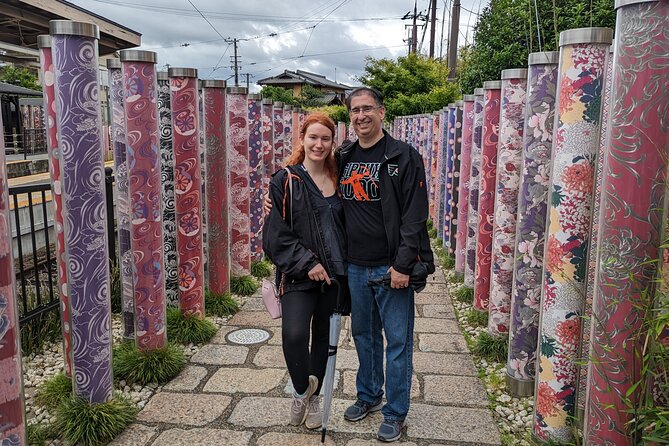
Kyoto rewards slow travel, but reality wins for most of us: you have one day, you want the big landmarks, and you still want to understand what you’re looking at. This tour is designed for exactly that. You’ll move through four high-impact areas—Fushimi, Arashiyama, Monkey Park, and Kinkakuji—without needing to stitch together trains, station exits, and walking directions.
What makes it feel practical is the structure. Instead of wandering, you’re guided from one point to the next. That matters in Kyoto, where popular sights can turn into maze-like crowds and getting off by one street can cost serious time.
Also, the included admissions are a real value lever. Paying on the spot for multiple entrances can be fine, but it’s still time you could spend walking, looking, and photographing. Here, you buy into the day knowing three of the busiest paid stops are already handled.
You can also read our reviews of more walking tours in Kyoto


Meeting at Fushimi Inari: start at the Kitsunezo fox
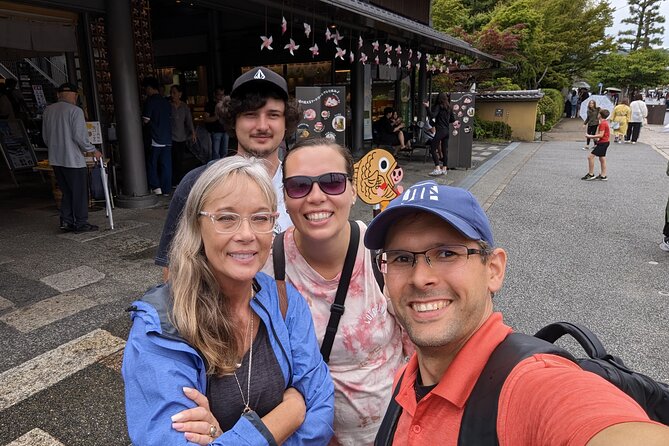
Your day starts at the fox statue called Kitsunezo at the entrance area of Fushimi Inari Taisha Shrine, in front of JR Inari Station. Your guide will be wearing the Japan Tour Adventure uniform, and you’ll get oriented right away—this is one of those small details that prevents a lot of first-day Kyoto confusion.
You’ll want to arrive early. The tour can’t wait for late arrivals because other groups are involved, and if you miss the start you can’t join that session. Build a buffer: Kyoto stations are big, signage can be a little confusing at rush times, and you don’t want to rush your way into the first shrine.
Fushimi Inari Taisha: torii gates with a plan
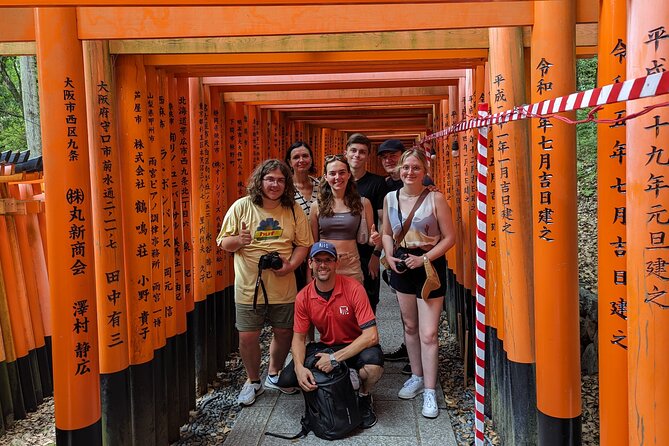
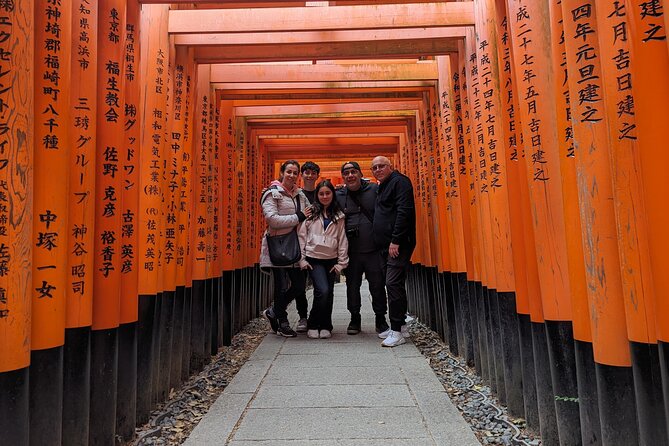
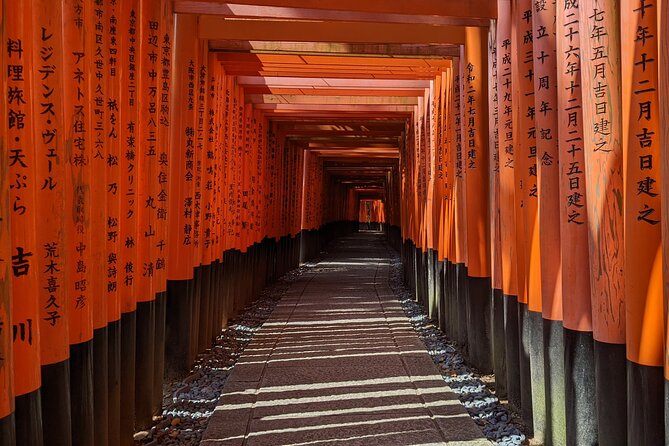
Fushimi Inari Taisha is the Kyoto post card that actually matches real life: thousands of vermillion torii gates winding up Mount Inari. This tour gives you about 1 hour 30 minutes at the shrine, and because the area is free-entry, you’re not split between ticket lines and wandering.
Here’s the real win of having a guide: you’ll understand what you’re seeing as you walk. Fushimi Inari isn’t just a photo route. It’s a living shrine complex with meaning behind the signs, the paths, and the way the gates mark devotion. A guide also helps you avoid the most frustrating dead ends—especially if you’re trying to see a lot without exhausting yourself on the steepest portions.
If you’re doing this tour as your first Kyoto day, Fushimi Inari sets the tone. It’s visually dramatic, easy to orient around, and it gets your eyes ready for the calmer temple mood later.
Arashiyama Bamboo Forest: ethereal without the hassle
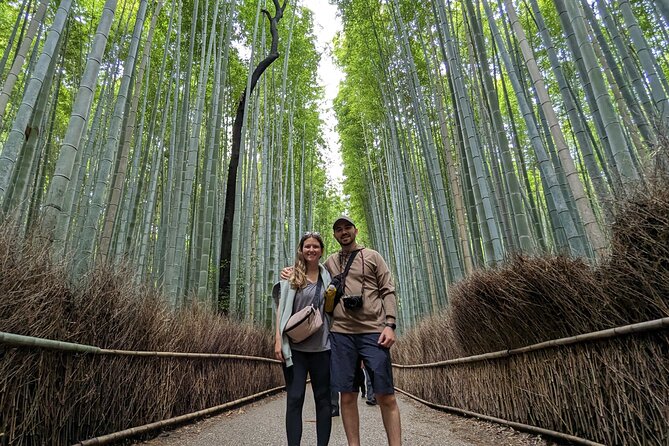
Next comes the Arashiyama Bamboo Grove, with about 1 hour 20 minutes to stroll through the bamboo. It’s a serene-feeling walk even though it’s famous, and the best part is how fast you move from shrine intensity to a quieter natural scene.
The tour also keeps you from burning time. Instead of trying to guess where to enter and how to reach Tenryu-ji efficiently, you follow a route that links these stops logically. That connection matters because Tenryu-ji sits right by the bamboo grove, so you’re not wasting your day between “almost there” locations.
One practical tip: treat this as a walking stop, not a lingering picnic. The day is long, and bamboo photography is timing-sensitive. You’ll do better by watching for good sight lines and then moving on rather than stopping so long that you run late for the next part.
Tenryu-ji Temple: UNESCO gardens in a focused window
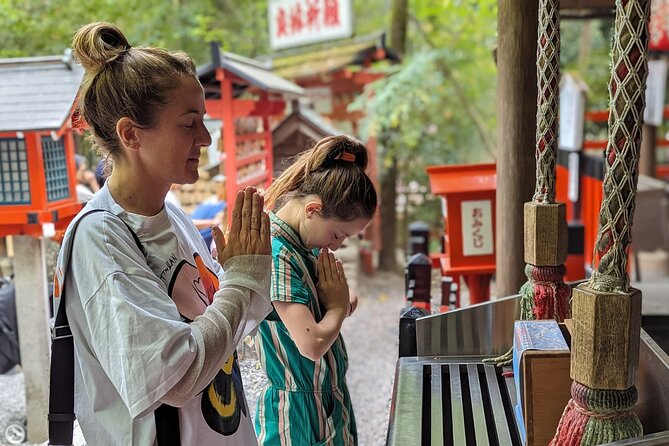
Tenryu-ji is a UNESCO World Heritage site and one of Kyoto’s important Zen temples, with about 40 minutes on the schedule and the entrance ticket included. This is where having a plan helps you focus. In a time-limited slot, you don’t want to spend your whole visit asking where to go next.
Tenryu-ji’s gardens are the key experience, and your guide can point out what to look for so the place doesn’t feel like “another beautiful garden.” Even in a short visit, you should come away with a clear sense of why it matters in the Zen tradition.
A balanced expectation: 40 minutes is enough for the highlights, not for an unhurried deep study. If you love temples and could spend all day reading every sign, you might want to return later on your own. But for many first-timers, this timing hits the sweet spot.
You can also read our reviews of more tours and experiences in Kyoto

Arashiyama main street, Togetsukyo Bridge, and lunch time
After Tenryu-ji, you get time to explore Arashiyama itself, about 45 minutes. This is the part of the day that feels more like real travel: browsing the main street, taking a break, and eating something that tastes like Kyoto.
The route includes a cross of Togetsukyo bridge and time to enjoy river views. That’s a nice reset. You go from temple stillness to street energy and then back to scenery, which keeps the day from becoming one long line of similar-looking spots.
Lunch is not included, but the tour builds in time for it. There’s also mention of a way to handle lunch without standing in long waits by joining the group at the right moment. If you want a smoother meal experience, take advantage of that window rather than searching randomly with a tightening schedule.
Monkey Park Iwatayama: the hike, the views, and the decision point
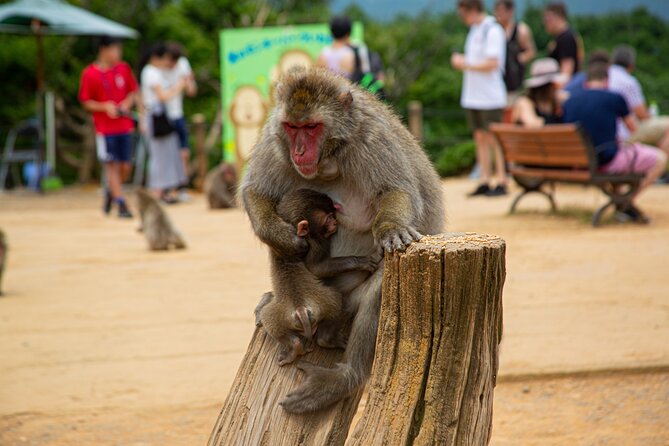
Monkey Park Iwatayama is the most physically demanding stop. It has about 1 hour 10 minutes on the schedule, the entrance is included, and you’ll face a short hike of roughly 15–20 minutes up a steep path to reach the area with the monkeys.
This is not a “shuffle along” part of Kyoto. If your knees or legs hate hills, you’ll feel it here. The tour is explicitly not recommended for people with leg or knee problems, and you should take that seriously—not as a formality.
The good news is flexibility. If you don’t want to do Monkey Park, you can take free time around the main area of Arashiyama and rejoin later at a specific catch-up time and meeting location. That’s a big deal because it keeps the rest of the day from feeling like a compromise.
In the reviews, people also mention fun close encounters and even feeding monkeys when conditions allow. I’d treat that as a bonus, not a guarantee, because on-site rules can vary. What you can count on is the payoff: the higher viewpoint and the chance to see Japanese macaques in their natural-ish setting.
Kinkakuji Golden Pavilion: finishing with the most photogenic temple
You finish with Kinkakuji Temple, also known as the Golden Pavilion. You get about 2 hours, and the entrance ticket is included. This is the capstone sight: the top floors are covered in gold leaf, and the reflection in the pond creates the most famous image in Kyoto for a reason.
Two hours is a comfortable amount of time here. You can walk the grounds, see the reflections from different angles, and take photos without feeling like you’re constantly on the move. It’s also a place where a guide can help you understand the temple’s place in Zen culture and why it’s constructed the way it is.
Even with guidance, expect it to feel popular. The trick is using your time well: aim for good views, take the photos you need, then slow down for what makes the pavilion special beyond the postcard shot.
The tour ends back at Kyoto Station, though you can leave directly after the last stop if you want to cut the return time.
Price and value: $97.87 for a full highlight chain
At $97.87 per person, this tour isn’t the cheapest way to see Kyoto. But it’s also not just “a guide walking you around.” The value shows up in three places.
First, admissions are included for multiple major stops: Tenryu-ji, Monkey Park, and Kinkakuji. That cuts both cost and decision-making. Second, you’re buying routing help and a guided flow across neighborhoods, which matters because Kyoto is made of neighborhoods that don’t connect in a straight line. Third, you get downloadable souvenir pictures from a private drive—small, but a nice extra for people who want the best shots without asking strangers.
What’s not included is also clear. Transportation between areas is on you (trains and buses), and lunch and drinks are not included. That’s normal for Kyoto tours, but it’s worth budgeting so you don’t end up paying sticker prices while hungry.
If you’re the kind of traveler who likes to plan but hates building itineraries from scratch, this pricing makes sense. If you already know the transit system well and you’re happy buying your own tickets one by one, the “included” piece is less of an advantage.
Walking and transit logistics: the part that can make or break your day
This is a walking tour using public transportation, not a bus tour. You’re covering a lot of ground, moving between stops by train and bus, then walking temple paths and park steps.
That means two things for your comfort:
- Wear good shoes. You’ll be on foot repeatedly, and Monkey Park includes a steep hike.
- Use an IC card like Suica or ICOCA. Transportation isn’t included, and IC cards make payments fast instead of fiddling with paper tickets.
You should also know that the tour is approximate at about 8 hours and can vary by around 30 minutes. If you’re trying to catch a late train or have dinner reservations, plan some breathing room.
There’s one more practical touch: your guide may contact you via WhatsApp around departure time if you haven’t arrived. Downloading WhatsApp beforehand is smart, since it can save you from confusion when you’re figuring out the meeting point.
Who should book this Kyoto walk (and who might not love it)
This tour fits best if you want a high-yield day. It’s ideal for first-timers, people with limited time, and travelers who prefer a guided route that reduces stress. The small-group format also helps; you’re less likely to feel like a number in a moving crowd.
It’s also a good option if you like photos but don’t want to spend your time researching the best angles. The route naturally strings together big photo moments: torii gates, bamboo, monkeys from a viewpoint, and the Golden Pavilion reflection.
I’d be cautious if you have mobility issues. Between the general walking and the steep Monkey Park path, this isn’t the easiest day on your feet. If that hike scares you, take the skip option and enjoy Arashiyama main area time instead.
Should you book this full-day Kyoto walk?
I think it’s a strong choice if you want Kyoto’s biggest hits in one organized day and you like having someone handle navigation and admissions. The tour’s value is strongest when you count included entrances like Tenryu-ji, Monkey Park, and Kinkakuji, plus the guidance that keeps your day moving.
Book it if:
- You have one day and want to cover Fushimi Inari, Arashiyama, monkeys, and Kinkakuji
- You’re comfortable with lots of walking and can do a 15–20 minute steep hike (or you’re okay skipping that part)
- You want a guided flow instead of planning every train and ticket
Skip it or consider an easier option if:
- Your legs or knees don’t handle hills well
- You want a slower, quieter pace with fewer stops
If you’re ready for a full day on your feet, this is one of the more efficient ways to experience Kyoto without turning your vacation into a logistics project.
FAQ
What is the duration of the Kyoto Walk in Fushimi, Arashiyama, Monkey, and Kinkakuji?
The tour runs for about 8 hours, with timing that can vary by around 30 minutes.
What does the $97.87 per person price include?
It includes a bilingual local guide, entrance tickets for Tenryuji Temple, Monkey Park Iwatayama, and Golden Temple (Kinkakuji), plus downloadable souvenir pictures from a private drive.
Are Fushimi Inari Taisha Shrine and the Arashiyama Bamboo Forest included with admission?
Yes for the tour experience, but those specific stops list admission as free. The included paid admissions are for Tenryuji, Monkey Park, and Kinkakuji.
Is transportation included?
No. Transportation (train and bus) is not included, and it’s recommended to use an IC card like Suica or ICOCA.
Is this a bus tour?
No. This is a walking tour using public transportation, not a bus tour.
Where do we meet the guide?
You meet at the fox statue called Kitsunezo at the entrance to Fushimi Inari Taisha Shrine, in front of JR Inari Station.
Do I need to be able to hike at Monkey Park?
You should. The access to the top includes a short hike of about 15–20 minutes through a steep path, and the tour is not recommended for people with leg or knee problems.
Can I skip Monkey Park and still enjoy the day?
Yes. If you do not wish to go, you’ll have free time around the main area of Arashiyama, and there’s a specific time and meeting location to catch up with the group.
What group size should I expect?
It’s a shared group tour with a maximum of 10 travelers, keeping it small rather than large-bus crowded.
Will I get an English-speaking guide?
English is the guaranteed language. Other languages (French, German, Spanish) may be available, but you can’t assume a specific language unless you contact in advance.