REVIEW · KYOTO
Full Day Hiroshima and Miyajima Tour by Bullet Train from Kyoto
Book on Viator →Operated by JTB Global Marketing & Travel Inc. · Bookable on Viator
Hiroshima and Miyajima in one long day. This full-day trip ties together UNESCO sights and a rare mix of serene island beauty and sobering World War II history, all with a guide-led flow built around the Shinkansen. You start in Kyoto, ride to Hiroshima, cross by boat to Miyajima, then return to Hiroshima for the Peace Memorial Park and Museum.
I especially like how the tour reduces stress on transport. Your group meets at Sunrise Tours Desk inside Avanti near Kyoto Station, then you’re guided onto the train, with the return ride timed back to Kyoto in the evening. I also love the Miyajima contrast: seeing deer on the Sacred Island area and visiting Itsukushima Shrine where the torii gate can look like it’s floating on water at high tide.
The main drawback is simple: it’s a long day and the time is tight at key stops. Lunch is on your own on Miyajima, and some people have felt the Hiroshima Museum or island time can be rushed depending on your pace.
In This Review
- Key highlights to know before you go
- Meeting Point in Kyoto: Avanti Desk and the 7:30am Start
- The Kyoto-to-Hiroshima Shinkansen Ride: Time-Saving in Plain Sight
- Miyajima Arrival: Ferry Transfer and the Sacred Island Feel
- Itsukushima Shrine: 6th-Century Roots and the Floating-Torii Moment
- Lunch on Miyajima (Not Included): Eat Well, Then Be Ready to Move
- Heading Back to Hiroshima: Boat Ride and a Quick Reset
- Genbaku Dome Stop: What Survived and Why It’s Preserved
- Hiroshima Peace Memorial Museum: 1 Hour of Guided Context That Matters
- How the Day Really Feels: Tight Stops, Long Hours, and a Chance to Adjust
- Guides and Group Size: Why Humor Can Coexist With Gravity
- Price and Value: Why $399.71 Can Be a Deal for This Route
- Who This Tour Suits Best (and Who Should Skip It)
- Should You Book This Kyoto to Hiroshima and Miyajima Tour?
- FAQ
- What time does the tour start, and where do I meet?
- How long is the full day trip, and when do we return to Kyoto?
- Is lunch included in the tour price?
- Is there an English guide during the whole tour?
- Are the main admission tickets included?
- Do I get reserved seats on the bullet train?
- Can I cancel for free?
Key highlights to know before you go
- Round-trip Shinkansen from Kyoto to Hiroshima so you don’t have to plan train timing all day
- Itsukushima Shrine on Miyajima with the famous water-side torii effect at high tide
- Genbaku Dome (Atomic Bomb Dome) plus the nearby memorials for context and reflection
- English guide support during the Hiroshima segment, including the museum visit
- Lunch is not included and it’s your responsibility to eat on Miyajima during the allotted break
- Small-ish groups (max 40) keep movement manageable even with a full itinerary
Meeting Point in Kyoto: Avanti Desk and the 7:30am Start
Your day begins at 7:30am, meeting at the JTB SUNRISE TOURS DESK inside Avanti (B1F), across from Kyoto Station Hachijo Exit. This matters more than it sounds, because if you miss the group at the station, you lose momentum fast on a trip that runs on tight connections.
Once you meet, staff guide you on foot to Kyoto Station. That little “walk with someone who knows the route” is a real value on busy mornings, especially if you’re not yet fully comfortable with Kyoto Station’s layouts.
You should also know there’s no hotel drop-off at the end. The tour finishes back at Kyoto Station around 9:00pm, so plan your evening transit accordingly.
You can also read our reviews of more tours and experiences in Kyoto


The Kyoto-to-Hiroshima Shinkansen Ride: Time-Saving in Plain Sight
The heart of this tour is the round-trip Shinkansen. You’ll take the bullet train from Kyoto Station to Hiroshima Station, and the ride is listed at about 2 hours each direction (the full stop timing in the day totals roughly 1 hour 40 minutes for each train segment).
Why this matters: you’re not trying to “day-trip” Hiroshima and Miyajima using slower regional trains. With the Shinkansen, you can actually fit Miyajima + Hiroshima highlights into one day without feeling like you’re spending your vacation commuting.
One more detail: the tour notes reserved seating is used, with options for standard car or Green Car on the return, but seats “may not be designated.” In normal language, that means you should arrive early enough to find your assigned area quickly once you board.
Miyajima Arrival: Ferry Transfer and the Sacred Island Feel
After you reach Hiroshima, the tour transfers you to Miyajimaguchi by train or vehicle, then you connect to a boat crossing to Miyajima. The trip around here is part of the charm: you’re changing modes (train → vehicle/train → ferry → island walk), and the guide keeps the rhythm so you aren’t wrestling logistics while also trying to enjoy the scenery.
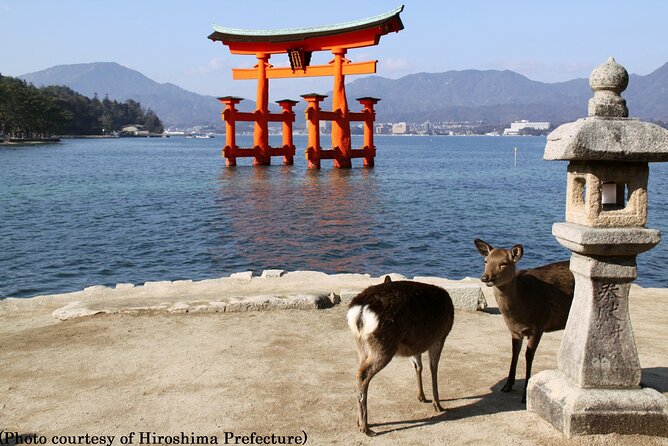
On Miyajima, your tour ties in with the island’s special reputation as the Sacred Island. The highlight expectation is clear: you’ll visit Itsukushima Shrine, famous for its water-side setting and the torii gate that appears to float at high tide.
You can also spot tame deer roaming near key areas. They’re not just a cute photo opportunity—your time on the island will feel more like a living place than a theme park stop.
Itsukushima Shrine: 6th-Century Roots and the Floating-Torii Moment
Your shrine visit is scheduled at about 1 hour, with an included admission. The shrine’s origin is listed as established in the 6th century, and the architecture is described as Shinden-zukuri style, associated with noble residence design from the Heian period.
Practically, what this means for your visit: you’ll get more than a quick “here’s the torii” photo. Because the shrine is both historic and photogenic, you’ll likely want those extra minutes to look at the structure, the water setting, and the flow of paths around the grounds.
If you care about photos, remember that the island experience moves in bursts: you’ll have people taking pictures at the same viewpoints. Go slow, pick one or two favorite angles, and don’t burn your whole time chasing a single perfect shot.
Lunch on Miyajima (Not Included): Eat Well, Then Be Ready to Move
On Miyajima, lunch is your responsibility—not included in the tour price. The tour gives you time for it during the island block, which is listed at about 1 hour total at Miyajima (and the narrative describes roughly 45 minutes on the island before lunch).
That time window is the key trade-off. If you sit down for a long meal, you may feel rushed when it’s time to head back to the ferry and the Hiroshima segment.
What can you eat? The tour description points to foods you’ll find around the island, including oysters, Hiroshima-style okonomiyaki, and conger eel rice bowl. This is a good place to treat lunch as part of the experience rather than a checkbox.
One more practical note: the tour doesn’t mention vegetarian options. If you eat vegetarian, you’ll want to check menu signs quickly and decide fast so you don’t lose time.




Heading Back to Hiroshima: Boat Ride and a Quick Reset
After lunch, the itinerary has you cruise back to Hiroshima. Even if you’ve already mentally checked out of the island by then, use the ride as your reset. It’s one of those natural breaks in a long day, and it helps you shift gears from “pretty island” mode to “heavy history” mode without feeling like you got whiplash.
In other words: the schedule may look packed on paper, but the boat gives you a breath in real time.
Genbaku Dome Stop: What Survived and Why It’s Preserved
Next up is the Atomic Bomb Dome, also called the Genbaku Dome, and it’s scheduled for about 40 minutes with no admission ticket listed. The tour frames it as a symbol of the bombing in WWII and notes it’s one of the few buildings preserved as it was.
Nearby, the itinerary includes the Children’s Peace Monument, draped with thousands of origami cranes made by children, and the Atomic Bomb Memorial Mound, which contains the ashes of 70,000 bomb victims (noted as many unidentified or without surviving relatives to claim them).
This stop is emotionally heavy. The practical way to handle it is to give yourself a pace: read the basic plaques once, then spend a few quiet minutes looking at the building itself. If you rush through, the weight can turn into stress instead of reflection.
Also, because this is a quick stop, you won’t feel like you need to solve everything in 40 minutes. The tour’s goal is orientation and context so you can make the museum visit more meaningful later.
Hiroshima Peace Memorial Museum: 1 Hour of Guided Context That Matters
Your Peace Memorial Park and museum portion is listed as about 1 hour for the museum. The park itself is described as a UNESCO World Heritage site, established in 1949 after the Pacific War ended, with the museum noted as an Important Cultural Property of Japan.
Here’s why I think this museum timing works for most people: it’s a guided visit, so you’re not wandering with random questions. The guide leads you through exhibits tied to the atomic bomb that devastated Hiroshima on August 6, 1945, and the city’s recovery after World War II.
That guided structure is especially helpful if you’re traveling with kids or you want to understand what you’re seeing instead of just reading signage. In past groups, guides have also been praised for humor and pacing, even while covering such a serious subject. Still, a museum visit will never be light.
Audio and crowding are the two things to watch. Some people have said audio equipment issues reduced what they could hear. If your group uses any form of listening devices, test them early and ask the guide to repeat key instructions if you’re missing them. And because it can get crowded, don’t expect to read every single label during the allotted time.
How the Day Really Feels: Tight Stops, Long Hours, and a Chance to Adjust
This tour is about 13 hours 20 minutes from start to finish. You’ll be in motion for most of the day: Shinkansen legs, transfers, ferry crossing, shrine grounds, then Hiroshima highlights.
The itinerary also sets clear time blocks:
- Itsukushima Shrine: about 1 hour
- Miyajima island time: about 1 hour
- Atomic Bomb Dome: about 40 minutes
- Peace Memorial Museum: about 1 hour
That can feel perfect if you like a structured highlights tour. But if you want to linger—especially at the museum—you might want more time.
One real-world tip from the guide approach on these days: the tour can be adjusted by signing out and staying longer at the museum, but it requires handling your return Shinkansen ticket separately. So if you’re the type who hates being rushed, build in extra flexibility in your decision-making.
Guides and Group Size: Why Humor Can Coexist With Gravity
The tour includes a National Government Licensed English Guide Interpreter during the Hiroshima segment, which is the part that tends to require translation and emotional nuance. That’s an important detail. Even if you read the signs, the guide’s explanations help you connect exhibits to a timeline and to the city’s recovery.
Also, group size is capped at 40 travelers. That’s enough people to feel like a real trip, not so many that it becomes chaos at each stop.
Guide quality shows up strongly in the feedback. People have praised guides by name—Angela, Azusa, Sato, Takeshi, Taeko Watanabe, Akiko, Marie, Masoko, Hiro, and Masako—and many comments focus on organization, humor, and how clearly guides explained what you were seeing. On the flip side, at least one person felt their guide performance dragged the experience down. That’s the risk with any guided day: the content matters, but the guide shapes how you feel while you absorb it.
Price and Value: Why $399.71 Can Be a Deal for This Route
The price is listed at $399.71 per person. That sounds high until you match it to what the day includes: round-trip Shinkansen from Kyoto to Hiroshima, transfers to Miyajimaguchi, the ferry ride, a guided Hiroshima museum experience with an English interpreter, plus admission fees for key sites (Itsukushima Shrine and the Peace Memorial Museum).
Lunch isn’t included, but most of the costly parts are bundled:
- Shinkansen transport both directions
- Included admissions where specified
- Miyajima visitor tax
- Other admission fees and transportation costs included
Also, multiple accounts highlight that the company handles logistics and even helps secure reserved seats on the trains. That’s something you’d otherwise spend time coordinating—or money paying for—if you planned it alone.
So when is this a good value? If you want to see both Hiroshima and Miyajima in one day, and you’d rather pay for smoother routing than spend your vacation day figuring out trains, ferries, and museum pacing.
When might it feel less worth it? If you specifically want a long, self-paced museum visit, or if you want lunch included, or if you hate long days. In those cases, you might prefer a more flexible DIY plan.
Who This Tour Suits Best (and Who Should Skip It)
This is a strong fit if:
- You’re short on time in Japan but still want major Hiroshima and Miyajima highlights
- You like a guided structure that explains what matters
- You prefer having transport handled for you, especially with the Shinkansen involved
- You’re traveling with family and want an English guide during the Hiroshima portion
It may not be the best fit if:
- You want lots of unstructured time on Miyajima or at the museum
- You need lunch included in your package
- You’re traveling with younger kids who might find the museum’s images disturbing (the museum photos of injuries and the dead were specifically mentioned as potentially challenging for younger children)
Should You Book This Kyoto to Hiroshima and Miyajima Tour?
If you want an efficient day that hits the biggest sites with guided context, I’d say book it, especially if you’re new to Japan or you don’t want to juggle train and ferry logistics on a heavy-history day.
But go in with eyes open: it’s long, and the time at each stop is planned to be a highlights pass rather than a deep stay. If you’re the type who needs extra museum time, consider arranging to stay longer after the guided portion and manage your return train separately.
FAQ
What time does the tour start, and where do I meet?
The tour starts at 7:30am. You meet at the JTB SUNRISE TOURS DESK inside Avanti (B1F) near Kyoto Station.
How long is the full day trip, and when do we return to Kyoto?
The duration is about 13 hours 20 minutes. You return to Kyoto Station around 9:00pm.
Is lunch included in the tour price?
No. Lunch is not included. You have time to eat on Miyajima, and you pay for meals on your own.
Is there an English guide during the whole tour?
An English guide interpreter is included during the Hiroshima segment. Other parts like the Miyajima and shrine time include on-site elements, but the Hiroshima guidance is specifically called out as English-language support.
Are the main admission tickets included?
Yes for the listed admissions. Itsukushima Shrine and the Hiroshima Peace Memorial Museum have admission tickets included, and the Atomic Bomb Dome stop is listed without an admission ticket.
Do I get reserved seats on the bullet train?
The itinerary notes reserved seating in either a standard car or the premium Green Car for the train segment. It also notes that seats may not be designated.
Can I cancel for free?
Yes. Free cancellation is available up to 24 hours in advance for a full refund. If you cancel less than 24 hours before the experience starts, the amount paid is not refunded.