REVIEW · KYOTO
Fukusa Shibori Class
Book on Viator →Operated by Kyoto Shibori Museum · Bookable on Viator
Kyoto has a way of turning craft into a lesson you can feel. This kasamaki and nuishime shibori class has you working with traditional wrapping and stitching methods, right inside the Kyoto Shibori Museum. I especially like the mix of museum viewing plus hands-on practice, so you get context and a finished keepsake, not just a quick demo.
What I like most is the hands-on part where you actually wrap, stitch, and pull the threads to shape the dyeing outcome. I also appreciate that the class is guided by Roy, who keeps things clear and patient so you can follow the process and end up with a satisfying result.
One thing to consider: this is a focused class. You’ll spend your time on two methods—kasamaki and nuishime—so if you’re hunting for a broader buffet of shibori styles, you may want to pair it with extra museum time on your own.
In This Review
- Key Things I’d Look For in This Shibori Class
- Kyoto Shibori Museum: A Calm Start in the Middle of the City
- Kasamaki Shibori and Nuishime Shibori: What You’re Really Learning
- From Tools to Hands-On: How the Class Typically Runs
- What “Traditional Tools and Fabrics” Means for You
- Your Finished Cloth: The Take-Home Moment (and Why It’s Worth It)
- What to do with it after
- Time, Group Size, and the Overall Pace
- Price and Value: Is $71.67 a Good Deal?
- Who This Shibori Class Is Best For
- Planning Tips: Getting the Most Out of Your 60–90 Minutes
- Should You Book the Fukusa Shibori Class?
- FAQ
- Where is the meeting point for the class?
- How long does the Fukusa Shibori class take?
- What shibori techniques will I learn?
- What will I be making during the class?
- Do I take anything home?
- What is the minimum age to join?
- How large is the group?
- Do I receive a mobile ticket?
- Is museum admission included?
- What is the cancellation policy?
Key Things I’d Look For in This Shibori Class

- Kasamaki + nuishime techniques in one session, so you’ll compare how different stitching leads to different patterns
- Museum displays and shop time, which helps you understand what you’re making before you start dyeing
- Small group size (max 15), which makes it easier to get help while you’re wrapping and pulling threads
- A finished silk cloth you take home, sized at 38cm x 38cm
- Orientation support, including an info video mentioned in class feedback, plus staff guidance
Kyoto Shibori Museum: A Calm Start in the Middle of the City
This class starts at the Kyoto Shibori Museum in Nakagyo Ward (135-5 Shikiamichō). Even if Kyoto traffic and crowds make you want to move fast, this stop feels like a breather: you’re stepping into a space set up for craft learning, not just sightseeing.
I like that the museum part isn’t tacked on as an afterthought. You get prime examples of classic kasamaki and nuishime work to look at, which helps your brain understand the goal before your hands start doing the work.
Also, this is a smart choice when the weather is trying to ruin your plans. One bit of class feedback that stuck with me: it can be a nice way to spend a hot afternoon without giving up on Kyoto.
You can also read our reviews of more tours and experiences in Kyoto

Kasamaki Shibori and Nuishime Shibori: What You’re Really Learning
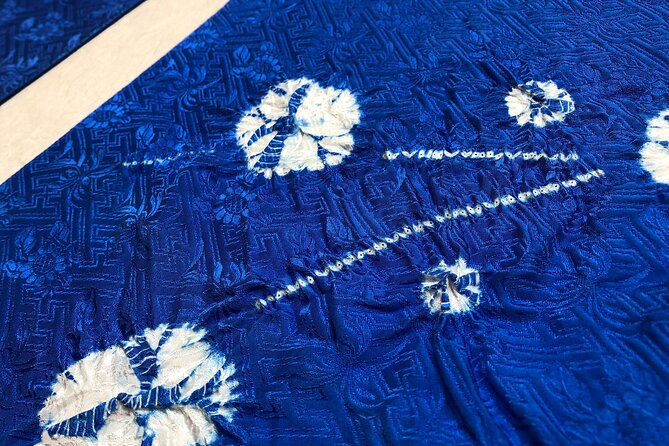
You’ll focus on two shibori cloth-wrapping techniques: kasamaki and nuishime. The point isn’t only to copy a pattern; it’s to learn the mechanics behind the look—how resisting dye in one area creates the final design.
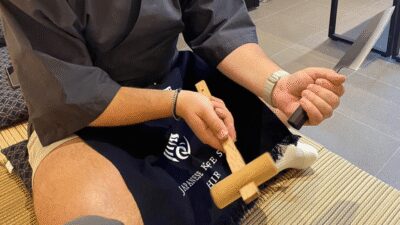
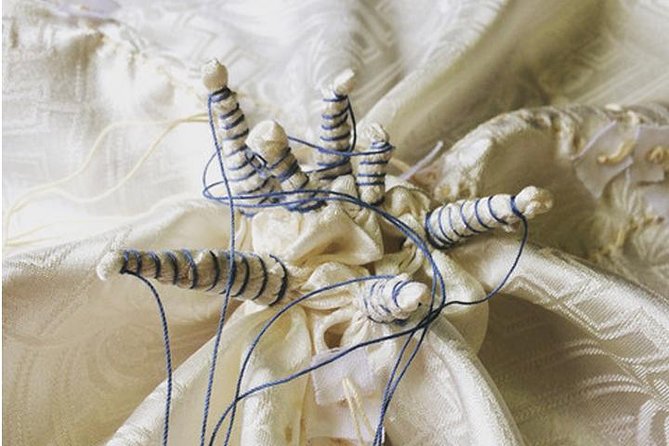
Kasamaki shibori (the wrapping cone method) works like this: you stitch around the shape you want to create, pull the thread tight, and then wrap the threaded fabric around a cone several times. You’re building tension and structure, then the dye has to work around those resist areas.
Nuishime shibori (the line-and-pull method) is built differently. Here, you stitch along a line and then pull the thread tight. That tightening creates controlled resist lines, and the dyeing brings them to the surface as pattern.
What I find useful is that these two methods teach contrasting thinking. Kasamaki is shape-and-wrap. Nuishime is line-and-tighten. If you want to do more shibori later, understanding that difference is half the win.
From Tools to Hands-On: How the Class Typically Runs
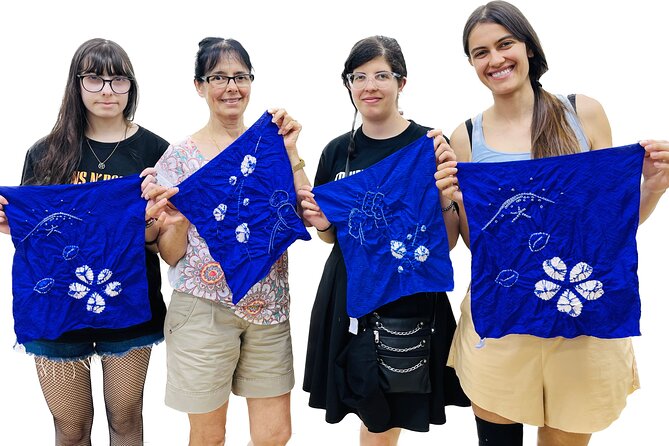
The class is listed as about 60 to 90 minutes. In practice, that’s enough time to learn the steps, handle traditional tools and fabric, dye the cloth, and still have time to understand what you just did.
You’ll start with guidance on the methods and what you’re making. Then comes the hands-on work: wrapping and stitching, with enough instruction to help you avoid common mistakes like uneven tension or loose pulling. Class feedback highlights how helpful the info video is, plus staff explanations in the room.
The teaching style matters here. With a small group, you can get quick clarification when something isn’t clicking. I also like that the process is supported by professionals nearby; it helps you feel like you’re learning a real craft, not just checking off an activity.
What “Traditional Tools and Fabrics” Means for You
The class description specifically calls out traditional shibori tools and fabrics. That’s important for value: you’re not just watching how it works in theory. You’re touching the same kind of materials and using the same kind of basic approach that craftspeople rely on.
Even if you’re a total beginner, you’ll likely walk out with confidence in the steps. And if you’re the crafty type, you’ll probably enjoy how much control tension and wrapping give you.
Your Finished Cloth: The Take-Home Moment (and Why It’s Worth It)
The goal of the session is a silk wrapping cloth that you dye using both techniques. The cloth size is 38cm x 38cm, which is big enough to appreciate the pattern closely but small enough to be practical as a keepsake.
This is where the class earns its price. You don’t just leave with photos. You leave with an object that shows the result of your effort: the tension you created, the areas you resisted from dye, and the contrast that comes out after dyeing.
Class feedback makes it clear that the final look is satisfying. The best kind of craft class gives you a before-and-after story: you start with fabric and thread, and you end with something you can hold and inspect for details.

What to do with it after
The class calls it a silk wrapping cloth, so think of it as a small-format textile with a decorative purpose. You can fold it for storage, use it as a gift wrap accent, or display it where you can see the pattern up close. The practical advantage is simple: it’s meant to be used, not sealed in a drawer forever.
Time, Group Size, and the Overall Pace
This experience caps at 15 travelers, which changes the vibe. In a big workshop, you often end up waiting your turn. Here, the smaller size helps you keep moving and get help while you’re mid-step.
The timeframe—about 1 to 1.5 hours—also affects how enjoyable it is. You’re not committing your whole afternoon. You can combine this with museum browsing nearby, or even build it into a longer Kyoto day without scrambling to make the logistics work.
If you’re traveling with kids, the minimum age is 8. Adult pricing applies to any age, so you’ll want to consider whether your child can comfortably follow the steps and handle the materials for the class length.
Price and Value: Is $71.67 a Good Deal?
At $71.67 per person, this isn’t a bargain-basement activity, but it can feel fair when you compare what you actually get. You’re paying for:
- instruction on two distinct shibori methods (kasamaki and nuishime)
- time inside the Kyoto Shibori Museum with classic displays to learn from
- traditional tools and fabrics
- a take-home dyed silk cloth (38cm x 38cm)
Value is strongest when a class includes both guidance and materials. Here, the session ends with a finished textile you can take home, which is exactly the kind of outcome that makes the price easier to swallow.
Also, free museum admission is indicated for the experience. That matters because it means the class experience isn’t only about the workbench. You’re also using the museum as part of the learning.
Who This Shibori Class Is Best For
This is a great fit if you:
- want a hands-on Kyoto activity that isn’t dependent on luck or lines
- like learning a process, not just buying a souvenir
- enjoy textiles, pattern-making, or slow crafts
- want a structured intro to shibori methods you can attempt again later
It’s also a good option if you’re trying to plan around heat or rain. The session runs indoors and is designed to occupy a short block of time.
If you’re looking for a fast shopping stop, this isn’t that. This is a workshop class where your hands matter.
Planning Tips: Getting the Most Out of Your 60–90 Minutes
A few practical points can make your session smoother:
- Wear clothes you don’t mind getting a little messy. Even if the dyeing setup is controlled, you’ll be working with fabric and thread.
- Slow down when you’re pulling thread tight. Tension is the whole point for both kasamaki and nuishime.
- Use the museum examples before you start wrapping. Looking closely at patterns first makes your choices during the class feel more intentional.
- Ask questions while you’re mid-step. With a group size up to 15, you can get clarification when it matters, not after you’ve already tied the fabric.
And if you’re the type who likes a friendly vibe: the class feedback highlights teachers and makers who are happy to help. That environment can turn beginner anxiety into straightforward progress.
Should You Book the Fukusa Shibori Class?
If you want a Kyoto craft experience with a clear outcome, I’d book it. You’re learning two shibori methods, seeing examples in the Kyoto Shibori Museum, and taking home a real piece of silk work sized at 38cm x 38cm. That combo—instruction plus museum context plus a finished artifact—is a strong value package for a one-time class.
Skip it if you already know you want a wide range of shibori styles in one go, or if you want a short show-and-tell rather than hands-on wrapping and dyeing. But for most people who want a meaningful, tactile Kyoto memory, this works.
FAQ
Where is the meeting point for the class?
The class meets at Kyoto Shibori Museum, 135-5 Shikiamichō, Nakagyo Ward, Kyoto, 604-8261, Japan. The activity ends back at the meeting point.
How long does the Fukusa Shibori class take?
The duration is about 1 hour to 1 hour 30 minutes.
What shibori techniques will I learn?
You’ll learn two methods: kasamaki and nuishime shibori.
What will I be making during the class?
You will dye a silk wrapping cloth (38cm x 38cm) using kasamaki and nuishime shibori methods.
Do I take anything home?
Yes. After the dyeing and cloth wrapping, you take your finished silk wrapping cloth home with you.
What is the minimum age to join?
The minimum age is 8 years. Adult pricing applies to any age.
How large is the group?
The class has a maximum of 15 travelers.
Do I receive a mobile ticket?
Yes, the experience includes a mobile ticket.
Is museum admission included?
Admission for the museum is listed as free as part of the experience.
What is the cancellation policy?
You can cancel for a full refund up to 24 hours before the experience’s start time. If you cancel less than 24 hours before, you won’t get a refund.